Minding the gaps of solar access
DC is on track to reach its goal of consuming 100% renewable electricity by 2032. As part of this goal, DC’s renewable portfolio standard (RPS) also mandates that 15% of this electricity must be generated from solar power facilities located in DC by 2041. DC’s Department of Energy and Environment (DOEE) continues to meet benchmark targets toward achieving these goals by investing in local solar development that benefits as many residents as possible.
DOEE administers two programs to incentivize solar development and help homeowners and renters benefit from solar energy. The first is called Switch Together and it provides discounted rooftop solar installations for customers who enroll in a seasonal aggregation. The second is Solar for All (SF), which provides different types of solar benefits to income-qualified homeowners and renters.
Switch Together (does not require income qualification)
Switch Together (recently rebranded from Solar Switch) is a household aggregation program that helps lower the cost of home solar installations. Switch Together is joint initiative between Solar United Neighbors, iChoosr, and DOEE. The program is only available to homeowners who are interested in rooftop generation systems.
Switch Together lowers home solar costs by soliciting interested applicants and holding annual reverse-bid auctions with local solar developers. The developers are incentivized to bid under market rates because winning the auction guarantees a significant pool of likely customers (pending home inspections and other considerations). As a result, Switch Together customers have saved an average of $6,134 per installation compared to average market-rate installations (This is the estimated average savings per system since summer of 2023, according to calculations by iChoosr).
Reverse-bid auctions and consumer aggregations are not new ideas. Community choice aggregations (CCAs), or municipal aggregations, for electricity and gas services exist in several states and countries. In fact, the District legally allows for municipal aggregations among energy consumers.
Federal solar tax credits from the Inflation Reduction Act (IRA) have also added a significant incentive to the mix. Switch Together customers get the benefit of lower upfront costs through aggregation and can then collect a federal tax deduction up to 30% of the total price of the panels, batteries, inverters, and installation labor. IRA solar credits were slated to sunset in 2032, but Congress recently passed the One Big Beautiful Bill on July 4, 2025, which forces solar tax credits to end on December 31, 2025 (seven years earlier than expected).
Switch Together customers have benefited from significant savings on home solar installations. From the summer of 2023 to the fall of 2024, Switch Together has helped 3,695 homeowners get discounted solar home installations. Only 209 homeowners enrolled in Switch Together ended up without installations, which could be due to factors including withdrawals from the program, structural issues with roofs or homes, or grid interconnection issues.
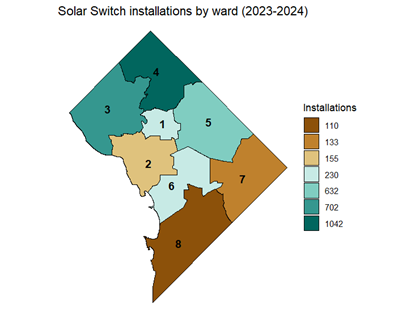
The number of home solar installations varies spatially across different neighborhoods in DC. When aggregated by ward, it is clear that there were a relatively large number of homeowners in wards 4, 3, and 5 who benefited from Switch Together; far fewer homeowners in wards 8, 7, 2, 6, and 1 benefited from the program. Figure 1 shows the number of homes receiving installations by ward. (Note that 461 homes did not have ward locations listed in the data and have been excluded from this map.)
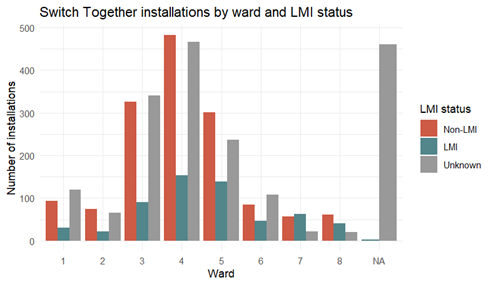
Switch Together customers are also asked to self-identify as “low- to moderate-income” (LMI) on the program application, though the program does not clearly define the thresholds for LMI. Figure 2 shows the number of self-identified LMI and non-LMI (i.e. higher income) customers who received installations in each ward. There are a significant number of customers who opted not to identify as LMI or non-LMI. Wards 4, 5, and 3 are home to the largest proportion of LMI homeowners who purchased solar installations as part of Switch Together. The largest number of installations among non-LMI households were in wards 4, 3, and 5. In fact, wards 3, 4, and 5 saw the largest numbers of installations generally. There is relatively little uptake of Switch Together benefits in wards 7 and 8, which have significantly lower median household income compared to all other wards in DC.
Homeowners who identified as LMI experienced a high success rate with 96% of these homeowners receiving rooftop systems through the program. By comparison, about 91% of non-LMI homeowners (presumably higher income) had rooftop systems installed. Switch Together has about 94% success rate overall to date (i.e. Homeowners who enroll end up with installed systems). Switch Together also records data on processing times, including grid interconnection wait times, and system capacities in kilowatts (kW). There are no significant differences in processing times between LMI and non-LMI program beneficiaries. The overall average processing time per homeowner from enrollment to interconnection was 136 days, or a little over four months.
Solar for All (requires income qualification)
Switch Together’s spatially clustered household impacts are complemented by DOEE’s income-qualified solar program, Solar for All (SFA). Households must fall at or below 80% of area median income (AMI) to qualify for SFA. The program provides no-cost solar benefits to residents in multiple ways. Homeowners are able to apply for free rooftop solar installations. Renters and condo owners may be eligible to receive electricity bill credits each month based on solar production from one of SFA’s community renewable energy facilities (CREFs). Building or property owners may be eligible to receive building solar installations that serve the building’s electricity demand as net-metered systems.
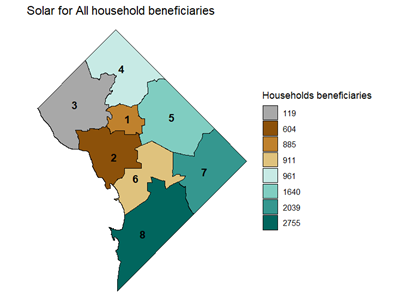
Figure 3 shows the geographic distribution of household-level beneficiaries of SFA. Beneficiaries of SFA are heavily concentrated in wards 7 and 8, which complements the Switch Together’s greater penetration in wards west of the Anacostia (i.e. wards 1, 2, 3, 4, 5, and 6). The total number of SFA beneficiaries varies but is currently estimated at just under 10,000 households. Beneficiary totals can fluctuate because of the nature of how benefits are shared; households that are subscribed to community renewable energy facilities qualify based on income and continue to receive electric bill credits until a qualifying factor changes, such as a move, income gains beyond 80% AMI, or disconnection. Beneficiaries of net-metered buildings continue to receive benefits of solar power produced by the building’s system as long as they remain tenants at those locations. Single-family homeowners with rooftop systems continue to benefit for the life of the system. (Note that there are also private community solar facilities to which DC residents can pay to subscribe.)
DOEE’s programs add significant solar capacity in DC
Meeting DC’s solar carveout and RPS goals requires rapid development of solar generation in the city. According to DC’s Public Service Commission, there are 18,333 RPS-eligible solar PV or solar thermal generators in the city (as of late 2025). These generators have a collective capacity of about 285 megawatts (MW). Of this total, Switch Together makes up about 1.6 MW and SFA constitutes about 51 MW. The two programs have, therefore, contributed about 18% of total solar capacity in the city. To meet the ambitious target of supplying 15% of DC’s electricity demand with local solar power will require scaling solar development to likely more than three times its current capacity.
If you have any questions or comments, please reach out to Jen Richmond at jennifer.richmond@dc.gov.